
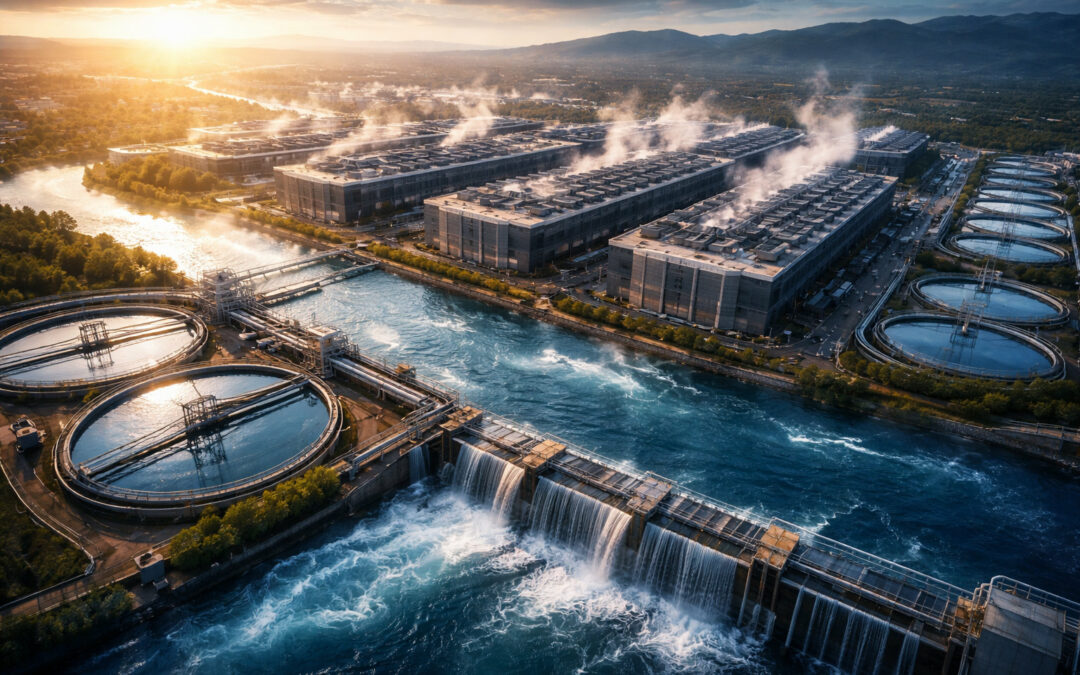
AI’s growing demand for water is raising alarms worldwide, but history shows us that every industrial revolution has tested our water systems and ultimately driven us to build better ones.
The Cloud Has a Thirst
Every question you ask an AI model, every image you generate, every automated task you hand off to a machine depends on something most people never think about: water. Not data. Not electricity. Water.
Behind the seamless experience of artificial intelligence sits a sprawling network of data centers, chip fabrication plants, and power stations. Together, they form what researchers now call the “AI economy,” and that economy is drinking deeply from the world’s freshwater supply.
Right now, the AI economy consumes roughly 6 trillion gallons of water every year. By 2050, that number is expected to more than double, reaching over 14 trillion gallons. To put that in perspective, that additional 8 trillion gallons of new water demand could provide every person on Earth with an extra 1,009 gallons of freshwater annually.
The question is not whether AI is valuable. The question is whether we are building this future responsibly or just hoping the water holds out.
Where the Water Goes
Data centers get most of the attention when it comes to AI and water consumption. A single hyperscale facility running at around 130 megawatts can use 45 million gallons of water per year just to keep servers from overheating. But data centers are only one piece of the puzzle.
The chips that power AI are manufactured using ultra-pure water in enormous quantities. A single liter of the water required for semiconductor fabrication can consume up to four liters of freshwater in the purification process. As chip complexity increases, the semiconductor sector’s water demand is projected to grow by more than 600% by 2050. That does not even account for the water needed to mine lithium, copper, and other materials that go into these components.
Then there is electricity. Much of the power feeding AI workloads still comes from thermoelectric plants that rely heavily on water for steam production and cooling. Before an AI model even runs its first calculation, water has already been consumed upstream.
The Location Problem
What makes this issue more urgent is not just how much water AI uses. It is where that demand is landing.
Nearly 40% of the world’s data centers sit in areas classified as high or extremely high water stress. Semiconductor fabrication facilities face a similar challenge, with roughly one-third of global fabs located in water-scarce regions. And demand spikes during summer months, the exact time when communities and farmers are already competing for limited supply.
This is not a hypothetical tension. Communities across the globe are already pushing back against data center projects that threaten local water resources. When a data center moves in and starts drawing millions of gallons from the same aquifer that supports homes, farms, and local businesses, the conversation shifts from abstract concern to real conflict.
History Says We Have Done This Before
Here is the part of the story that often gets overlooked. We have faced this kind of challenge before.
Every major industrial revolution has tested the limits of our water systems. The textile mills of the 19th century, the rise of electrification, the growth of heavy manufacturing through the 20th century, all of them pushed communities to the breaking point before we figured out how to adapt. The wastewater treatment plants, reservoirs, and hydroelectric infrastructure we rely on today were born from those earlier “water transitions.”
The AI revolution is forcing another reckoning. Managed poorly, this becomes a zero-sum fight between people and progress. Managed well, it becomes the catalyst for building water systems that are smarter, more resilient, and more sustainable than anything we have today.
So What Actually Needs to Change?
The conversation around AI and water tends to stop at awareness. People read the numbers, feel the weight of the problem, and then move on. But there are practical paths forward if the industry and the public are willing to take them seriously.
Start with what we are already losing. Before we talk about new demand, we need to confront the waste baked into the systems we already have. The world’s water utilities lose an estimated 84 trillion gallons of water every year through aging pipes, undetected leaks, and infrastructure that has been underfunded for generations. That is treated, processed water disappearing before it ever reaches a faucet. Smarter monitoring and early detection technology could recover a meaningful share of that loss, and the tools to do it already exist.
Then there is the question of how we think about water after it has been used. Most freshwater moves in one direction: it gets consumed and discharged. Globally, less than 10% is ever treated for reuse. That is a staggering missed opportunity, especially for industries like AI infrastructure where water can be reconditioned and cycled back through the system. The technology is not the barrier. The mindset is. When organizations start treating used water as an asset instead of a byproduct, the economics shift dramatically.
Finally, none of this works in isolation. Water is hyper-local. Every region has different supply constraints, different stakeholders, and different politics. The companies building data centers and the communities hosting them need to be at the same table, designing agreements where investment in AI infrastructure also strengthens the water systems around it. That is not idealism. It is the only model that scales without creating conflict.
The Real Choice
The AI revolution is not going to slow down. Investment is accelerating, models are getting larger, and the infrastructure to support them is being built at a pace we have never seen. The water those systems need will have to come from somewhere.
But this does not have to be the crisis it is often framed as. If the companies building the AI economy invest in the water systems that sustain it, if governments require transparency and accountability around water use, and if communities have a real voice in how shared resources are managed, this moment can be a turning point.
Not just for AI. For water itself.
The path forward demands that we stop pretending the cloud is weightless and start building infrastructure that reflects the true cost of the technology we are creating. Every GPU, every server rack, every new data center is an opportunity to either deepen the water crisis or help solve it.
The technology exists. The question is whether the will exists to use it.
Frequently Asked Questions
How much water does AI actually consume?
The AI economy currently consumes roughly 6 trillion gallons of water per year across data centers, semiconductor manufacturing, and power generation. By 2050, that figure is projected to more than double to over 14 trillion gallons. A single large data center alone can use 45 million gallons of water annually just for cooling.
Why do data centers need so much water?
Data centers house thousands of servers running around the clock. That processing power generates enormous heat that cannot be managed by air alone. Most facilities use water-based cooling systems where water circulates through cooling towers and heat is released through evaporation. Each cooling cycle sends water into the atmosphere permanently, and over time the losses are substantial.
Is data center cooling the only source of AI water consumption?
No. While data centers are the most visible consumers, semiconductor manufacturing and power generation actually use more water combined. Chip fabrication requires ultra-pure water in massive quantities, and thermoelectric power plants consume significant water for steam and cooling. The entire AI supply chain depends on water at every stage.
Why are data centers being built in water-stressed areas?
Data center placement is driven by factors like proximity to users, access to power infrastructure, tax incentives, and land availability. These priorities often take precedence over water availability, which is why nearly 40% of the world’s data centers are located in areas of high or extremely high water stress. This creates direct competition between AI infrastructure and the communities that already depend on those water resources.
What is a “water transition” and why does it matter?
A water transition is a fundamental shift in how society manages and distributes water in response to new industrial demands. History shows that every major industrial revolution has triggered one. The infrastructure we rely on today, from wastewater treatment to hydroelectric dams, came from earlier transitions. The AI revolution is creating conditions for the next one, and the choices made now will determine whether it strengthens or weakens global water security.
How can AI itself help solve the water problem it creates?
AI-powered monitoring and predictive maintenance tools can dramatically reduce water waste in aging infrastructure. The world’s water utilities currently lose 84 trillion gallons of water per year through leaks and system inefficiencies. Digital sensors and intelligent analytics can detect problems early, optimize distribution, and prevent losses before they happen. The same technology driving water demand can become the solution for reducing waste.
What role does water recycling play in sustainable AI growth?
Water recycling is critical. Currently, less than 10% of global freshwater is treated for reuse despite existing technology that makes it safe and scalable. Data centers and chip fabrication plants can be designed as closed-loop systems that recondition and reuse water instead of consuming fresh supply with every cycle. Treating recycled water as a strategic asset rather than waste could significantly reduce the net water impact of AI infrastructure.
What can property managers learn from the AI water crisis?
The AI water conversation highlights a universal truth: water waste at any scale is expensive and preventable. The same principles that apply to data centers, including real-time monitoring, early leak detection, and smarter distribution, apply directly to multifamily housing, hospitality, senior living, and other multi-unit properties. Understanding where water goes and catching problems early protects both the resource and the bottom line.
Key Takeaways
- The AI economy currently uses 6 trillion gallons of water annually and is projected to more than double by 2050.
- Water consumption extends far beyond data center cooling to include semiconductor manufacturing and power generation.
- Nearly 40% of global data centers are located in areas already facing high water stress.
- History shows that industrial revolutions drive water system improvements when managed with intention.
- Addressing existing water waste, expanding reuse practices, and fostering local collaboration between industry and communities are essential for sustainable growth.
- AI-powered monitoring tools can help reduce the 84 trillion gallons of water lost annually through aging infrastructure.
- Transparency, accountability, and community involvement are essential for turning this challenge into lasting progress.
Understanding water use is the first step toward managing it responsibly.
About Sensor Industries: We provide real-time water monitoring for multifamily, student housing, senior living, hospitality, and other multi-unit properties, helping teams cut waste, prevent damage, and protect NOI.