
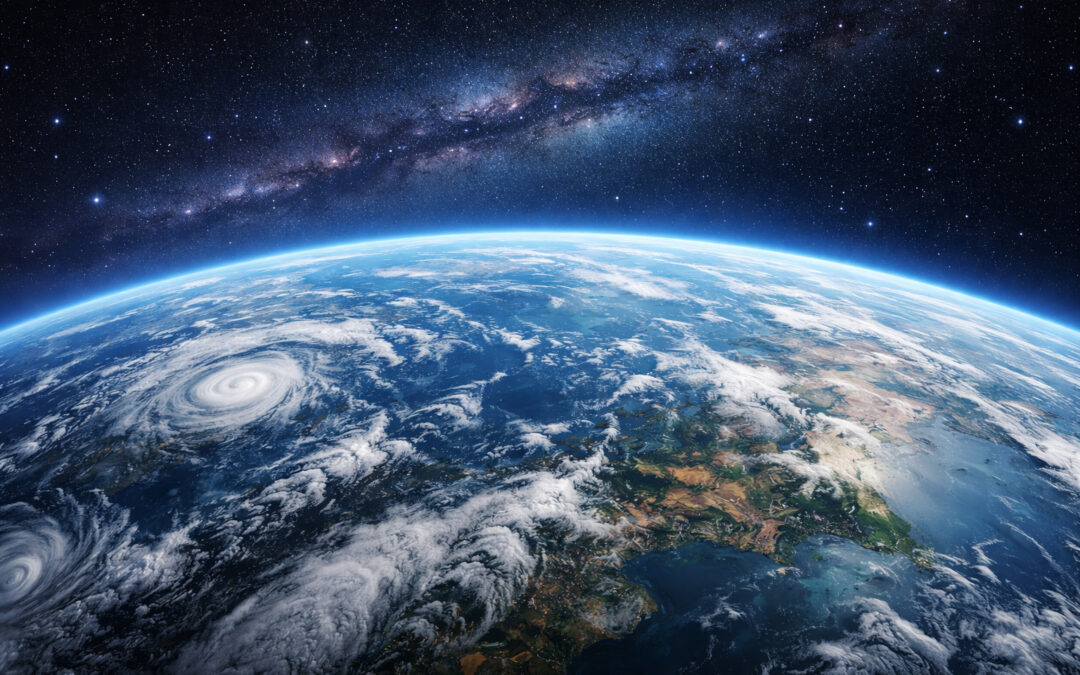
Earth stands apart as our Solar System’s water world, but the story of how our blue planet got its oceans has puzzled scientists for generations. Recent discoveries are challenging what we thought we knew about water’s origins.
The Traditional Theory: Delivery from Space
For decades, planetary scientists thought that Earth started dry. The conventional wisdom held that the rocky materials forming our planet were too close to the Sun and too hot to retain water during formation. This created a compelling mystery: if Earth began bone dry, where did all our water come from?
The answer seemed to lie beyond what scientists call the “snow line” – an invisible boundary in our early Solar System, roughly where the asteroid belt sits today between Mars and Jupiter. Beyond this line, temperatures were cold enough for water to exist as ice. Interior to it, materials remained dry.
Scientists initially focused on two suspects: comets and asteroids. Comets, those spectacular “dirty snowballs” of space, seemed like obvious candidates. However, researchers discovered an important clue in the deuterium-to-hydrogen ratio of water. Deuterium is a heavier form of hydrogen containing both a proton and a neutron, while regular hydrogen has just a proton. This ratio acts like a fingerprint, revealing where water originated.
When scientists compared Earth’s water signature to various space objects, comets didn’t match. But a specific type of asteroid called carbonaceous chondrites – carbon-rich asteroids also loaded with water – showed a striking similarity to Earth’s water.
This raised a new question: how did asteroids from beyond the snow line reach Earth? Computer simulations revealed that Jupiter and Saturn, our Solar System’s gas giants, created gravitational chaos during the early Solar System. Their massive gravitational forces scattered water-rich asteroids inward, sending them crashing into the young Earth. According to these models, asteroids delivered most of Earth’s water, with comets contributing perhaps 10% at most.
A Surprising Alternative: Homegrown Water
Recently, scientists have revived and tested an intriguing alternative hypothesis: what if Earth made its own water?
Picture Earth at its birth – a world of extremes. No solid ground existed, just a planet-wide ocean of molten rock: a magma ocean. Above this hellish landscape hung a thick atmosphere, but not the nitrogen and oxygen we breathe today. Instead, hydrogen gas dominated, gravitationally captured from the cloud of material that formed our Solar System.
The theory suggests these two components – hydrogen gas and iron oxides in the magma – could react together. The hydrogen would strip oxygen from the iron, combining to form water molecules. While this idea circulated as a theoretical concept for years, scientists only recently demonstrated it works in the laboratory.
Researchers used an ingenious device called a diamond anvil cell to test the hypothesis. This apparatus squeezes materials between two diamond tips, creating enormous pressure in a tiny space. Because diamonds are transparent, scientists can shoot lasers through them to heat the squeezed material to extreme temperatures, recreating conditions on early Earth. The experiments worked – they successfully produced water from iron oxides and hydrogen gas.
The Debate Continues
Both hypotheses remain in play, and the truth might involve both mechanisms. Scientists need better measurements of isotopic ratios from more asteroids and comets to refine the delivery theory. They’re also looking beyond our Solar System to test these ideas.
Future telescopes may detect water on planets orbiting distant stars. If these exoplanets consistently show signs of water regardless of their Solar System’s configuration, it would support the idea that planets naturally generate their own water. If water worlds only appear where conditions allow asteroid delivery from outer regions, it would strengthen the delivery hypothesis.
Why It Matters
Understanding water’s origin on Earth extends beyond satisfying scientific curiosity. It helps us estimate how common water worlds might be throughout our galaxy and guides the search for potentially habitable planets. Each piece of evidence brings us closer to understanding not just where we came from, but how rare or common our blue marble truly is in the cosmos.
The debate over Earth’s water represents science at its best – rigorous testing of competing ideas, refined through better observations and clever experiments. Whether delivered from space or forged in Earth’s primordial furnace, the water that fills our oceans, rivers, and bodies tells a story billions of years in the making.