

Artificial intelligence feels effortless from the user’s side. You type a prompt, ask for an email, summarize a report, build a formula, or generate a marketing idea, and within seconds something useful appears on the screen. The experience feels clean, instant, and digital, which makes it easy to forget that every AI response depends on physical infrastructure operating somewhere out of sight.
The Hidden Water Behind Every Prompt
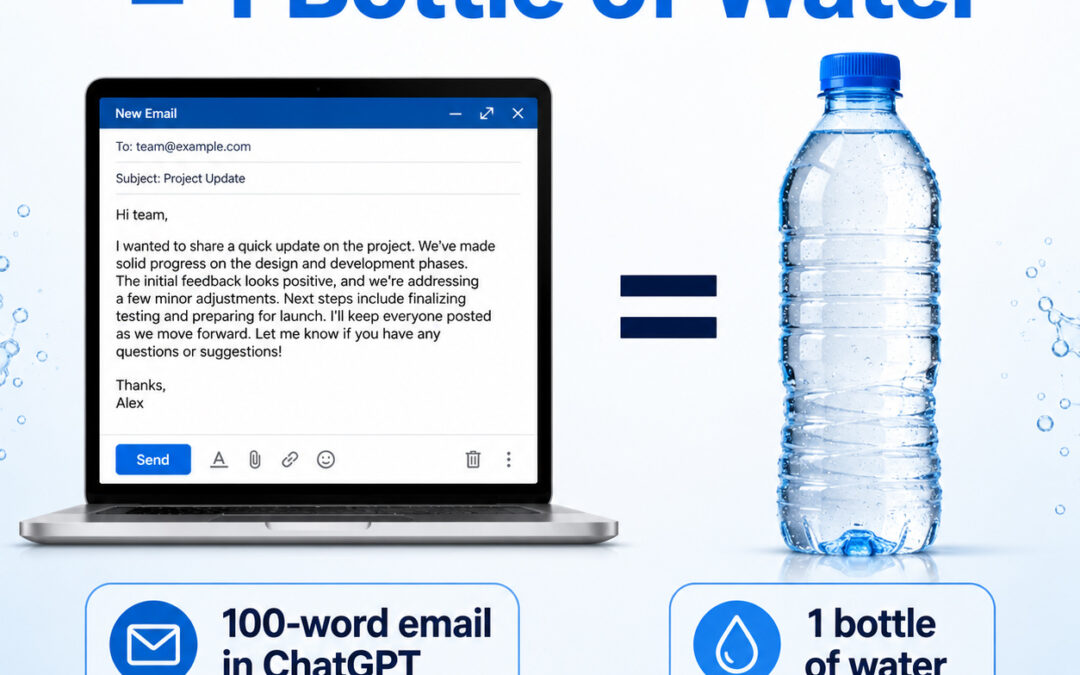
Behind each prompt are data centers filled with servers, processors, cooling equipment, electrical systems, and water. A recent SpaceDaily article highlighted research into the hidden water footprint of AI, including an estimate that writing a single 100-word email with ChatGPT may consume roughly 519 milliliters of water when both direct cooling and indirect electricity-related water use are considered. That is approximately the volume of a standard bottle of water.
The exact number can vary by location, cooling method, energy source, system design, and the complexity of the request. Still, the comparison is useful because it turns an invisible process into something people can understand. A short email does not feel resource-intensive. A chatbot response does not look like a physical event. But somewhere, servers are working, heat is being generated, electricity is being consumed, and cooling systems are helping keep the infrastructure online.
Why Water Entered the Sustainability Conversation
For years, the sustainability conversation around technology focused mostly on electricity. That focus made sense, because data centers already require enormous amounts of power, and AI is increasing that demand. Water is now becoming a larger part of the conversation because many data centers rely on cooling systems that use water to manage heat. As AI workloads grow, the need for cooling grows with them.
One Prompt Is Nothing. Billions Add Up.
A single prompt may not seem significant. A single generated email may not matter much on its own. The concern appears when billions of AI interactions are layered across businesses, consumers, software platforms, search tools, customer service systems, and automated workflows. AI is quickly becoming part of daily operations across the economy, and the infrastructure required to support that usage is expanding with it.
The SpaceDaily article cites research projecting that global AI demand could require billions of cubic meters of water withdrawal annually by 2027. That estimate reflects the broader infrastructure required to train, run, cool, and scale AI systems around the world. As adoption grows, the environmental impact of AI will depend on where the infrastructure is located, how efficiently it is cooled, and how clearly water usage is measured.
What This Means for Buildings and Water Management
This is where the story becomes especially relevant for anyone thinking about buildings, utilities, and resource management. AI can create real value. It can improve efficiency, reduce waste, identify patterns, accelerate decision-making, and help organizations respond faster to problems. In the water industry, AI has the potential to help property teams detect abnormal usage, catch leaks earlier, improve reporting, and make better operational decisions.
The challenge is making sure the infrastructure behind these tools is visible, accountable, and better understood.
Water has always been easy to overlook until something goes wrong. In buildings, a small leak can run for weeks. A toilet can waste hundreds of gallons a day without creating an obvious emergency. A fixture can operate inefficiently while everything appears normal from the outside. The same principle applies at a much larger scale with digital infrastructure. Water use may be hidden from the user, but it is still happening somewhere.
Water Is Local, and Visibility Matters
That visibility matters because water is local. A gallon used in one region does not carry the same impact as a gallon used somewhere else. Data centers located in water-stressed areas can create different pressures than facilities operating in regions with more resilient water supplies. As AI infrastructure grows, communities, utilities, operators, and technology companies will need better ways to understand the relationship between digital demand and physical resources.
The future of AI will be measured in speed, productivity, and model performance. It will also be measured in electricity, cooling capacity, local infrastructure, and water. The smarter the world becomes, the more important it is to understand what that intelligence costs to operate.
Frequently Asked Questions
How much water does a single AI prompt use?
Research cited by SpaceDaily estimates that writing a single 100-word email with ChatGPT may consume roughly 519 milliliters of water once both direct cooling and indirect electricity-related water use are counted. That is about the volume of a standard bottle of water. The exact figure varies by location, cooling method, energy source, system design, and the complexity of the request, so the number should be treated as a useful comparison rather than a fixed measurement.
Why do data centers use water?
Servers and processors generate significant heat, and many data centers rely on cooling systems that use water to manage that heat. As AI workloads grow, the need for cooling grows with them. Water use also comes indirectly through the electricity these facilities consume, since power generation itself often requires water.
Is AI water use a real concern or just hype?
A single prompt is not significant on its own. The concern appears when billions of AI interactions are layered across businesses, consumers, software platforms, search tools, customer service systems, and automated workflows. Research cited by SpaceDaily projects that global AI demand could require billions of cubic meters of water withdrawal annually by 2027 as the infrastructure to train, run, cool, and scale these systems expands.
How does AI water use connect to building and property water management?
The same principle that hides water use inside digital infrastructure also hides it inside buildings. A small leak can run for weeks, a toilet can waste hundreds of gallons a day, and a fixture can operate inefficiently while everything looks normal from the outside. AI can help property teams detect abnormal usage, catch leaks earlier, improve reporting, and make better operational decisions, but only if the underlying water data is visible and accountable.
Why does the location of a data center matter for water use?
Water is local. A gallon used in one region does not carry the same impact as a gallon used somewhere else. Data centers located in water-stressed areas can create different pressures than facilities operating in regions with more resilient water supplies. As AI infrastructure grows, communities, utilities, operators, and technology companies will need better ways to understand the relationship between digital demand and physical resources.
Can real-time monitoring make building water use more visible?
Yes. Water has always been easy to overlook until something goes wrong, and most waste happens quietly. Real-time water monitoring turns an invisible process into something teams can see and act on, surfacing leaks, abnormal usage, and inefficient fixtures before they become emergencies. That visibility is the same accountability the AI conversation is now demanding at a much larger scale.
Key Takeaways
- Every AI response depends on physical infrastructure, including servers, cooling equipment, electricity, and water.
- Research cited by SpaceDaily estimates a single 100-word AI email may consume roughly 519 milliliters of water, about the size of a standard water bottle.
- The figure varies by location, cooling method, energy source, system design, and request complexity.
- Sustainability conversations once focused on electricity, but water is now central because many data centers cool with it.
- One prompt is trivial. Billions of daily interactions across the economy are not.
- Global AI demand could require billions of cubic meters of water withdrawal annually by 2027.
- Water is local, so impact depends heavily on where infrastructure is built and how efficiently it is cooled.
- The same invisibility that hides AI water use hides leaks and waste inside buildings, which is why visibility and measurement matter.
Make Your Building’s Water Use Visible
The water you cannot see is the water you cannot manage. See it in real time.
About Sensor Industries: We provide real-time water monitoring for multifamily, student housing, senior living, hospitality, and other multi-unit properties, helping teams cut waste, prevent damage, and protect NOI.