
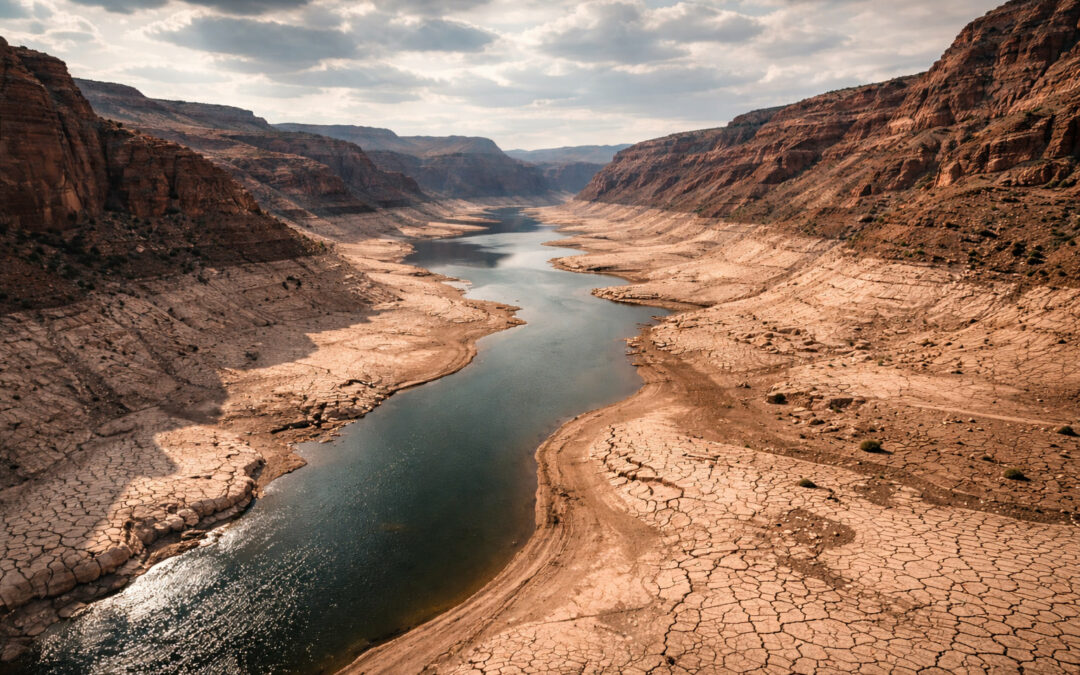
The West is negotiating with a river that is no longer keeping its promises. And the next set of decisions will shape costs, risk, and resilience for millions of people and the properties they live and work in.
The American West is approaching a water reckoning, and the warning signs are no longer subtle. In late January, leaders from across the region traveled to Washington, D.C. for an emergency-style summit convened by the Department of the Interior. The topic was simple and unsettling. How do seven states share a river that no longer has enough water to meet decades-old promises?
At the center of the debate is the Colorado River, a system that supplies water to roughly 40 million people, supports billions of dollars in agriculture, and sustains some of the fastest-growing cities in the country. For years, the river has been shrinking under the combined weight of climate change, long-term drought, and structural over-allocation. Reservoirs like Lake Mead and Lake Powell have hovered near historic lows, offering a visible reminder that the math no longer works.
What makes this moment different is timing. Existing operating rules for the river expire soon, and the federal government has given states a tight deadline to agree on a new framework for managing shortages. If they fail, Interior officials could step in and impose cuts themselves. That outcome would almost certainly trigger lawsuits, deepen political divides, and inject more uncertainty into an already fragile system.
The fault lines are clear. Downstream states want firm, enforceable commitments to reduce water use across the basin. Upstream states argue that their legal rights and historical use patterns make mandatory cuts unfair or premature. Both sides agree on one thing. The river is delivering less water than it used to, and everyone will have to adapt.
At the Washington meeting, Interior Secretary Doug Burgum signaled a push toward a short-term, five-year agreement as a bridge to a longer-term solution. No deal was reached, but the tone suggested growing urgency. Federal funding, conservation incentives, and infrastructure investments were discussed as ways to soften the blow of future reductions. Still, optimism was cautious. The hard choices remain unresolved.
Why does this matter beyond the Colorado River Basin? Because this dispute is a preview of what water stress looks like in a warming world. Aging infrastructure, delayed detection of leaks, and reactive water management all amplify scarcity. When supplies tighten, every inefficiency becomes more expensive, and every undetected failure carries greater risk.
For property owners, operators, and municipalities, this moment underscores a shift that is already underway. Water can no longer be treated as a stable, low-risk utility. It is a strategic resource, one that affects operating costs, insurance exposure, asset value, and long-term resilience. Preventing waste is no longer just about conservation. It is about risk management.
Technology plays a critical role here. Knowing where water is used, where it is lost, and how quickly problems are detected can make the difference between adaptation and crisis. As policymakers debate allocations and legal frameworks, the private sector has an opportunity and a responsibility to reduce unnecessary demand and prevent avoidable losses right now.
The West’s water crisis will not be solved in a single summit or a single policy cycle. But the message coming out of Washington is unmistakable. The era of assuming water will always be there is over. The next chapter will reward those who treat water as the finite, valuable resource it truly is.
FAQs
Why are Colorado River negotiations happening right now
The current operating framework for managing shortages is approaching a transition point, and states are under pressure to agree on updated rules that reflect ongoing drought and reduced river flows.
What happens if the states do not reach an agreement
Failure to reach consensus increases the likelihood of federal intervention and litigation. Both outcomes can create uncertainty for long-term planning, water pricing, and regional investment decisions.
How can a regional water dispute affect my property operations
Water stress can lead to tighter restrictions, increased scrutiny on conservation, and higher costs. Properties that can reduce waste and demonstrate controlled usage are better positioned as policies evolve.
What is the fastest way to reduce water waste in multi unit buildings
Start with visibility. Continuous monitoring helps identify abnormal usage tied to running toilets, stuck irrigation, or hidden leaks so teams can fix issues early instead of discovering them on the water bill or after damage occurs.
Is this mainly a conservation issue or a risk issue
It is both. Waste reduction supports conservation goals, but it also reduces financial exposure from inflated utility spend, water damage, unit downtime, and insurance claims.
What is the best next step to evaluate Sensor Industries
Book a meeting. We will review your property type, current challenges, and operational goals, then outline how monitoring, alerts, and reporting can help reduce waste, prevent damage, and protect NOI.
Key takeaways
- The Colorado River Basin states are under pressure to agree on new shortage rules as negotiations remain stalled.
- Without agreement, federal intervention and litigation become more likely, increasing uncertainty across the West.
- Scarcity exposes waste, and property level water loss becomes harder to ignore as policies tighten.
- Multi unit buildings often lose water through quiet failures like running toilets and hidden leaks.
- Continuous monitoring and early detection reduce both operating costs and water damage risk.
- Water resilience starts with visibility and fast response, not occasional checks.
Ready to reduce waste and strengthen water resilience
About Sensor Industries: We provide real time water monitoring for multifamily, student housing, senior living, hospitality, and other multi unit properties, helping teams cut waste, prevent damage, and protect NOI.